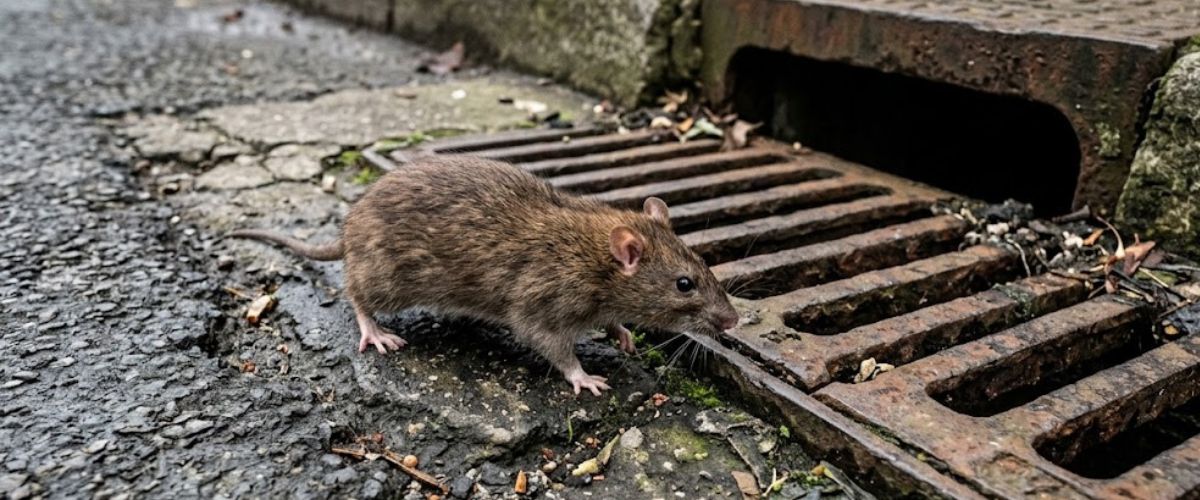
Norway rats in Chattanooga — the river-corridor rat
Norway rats (Rattus norvegicus) are Chattanooga's ground-level rat problem. Heavy-bodied, blunt-nosed burrowers, they establish colonies in soil near reliable food sources and move indoors through foundation gaps, floor drain openings, and below-grade wall penetrations. They are the dominant rat species along the Tennessee River corridor — the waterfront, the historic rail infrastructure, the restaurant-dense Southside and downtown blocks, and the utility corridors underneath the city.
Chattanooga's Norway rat population has two main drivers. First, the Tennessee River creates year-round habitat. Norway rats are strong swimmers, tolerate flooding well, and have colonized the riparian margins of the river from the Chickamauga Dam down through downtown and into South Pittsburg. When the river rises seasonally, riverside colonies get displaced uphill into residential and commercial properties — a pattern Chattanooga homeowners near the waterfront know well. Second, the city's restaurant and bar density downtown and on the Southside generates the consistent food availability that sustains large urban Norway rat populations year-round.
Unlike roof rats, Norway rats are poor climbers. If you are hearing activity in your attic or ceiling, it is almost certainly a roof rat, not a Norway rat. Norway rat activity shows up in basements, crawl spaces, ground-level wall voids, under concrete slabs, and in outdoor burrow systems along foundations, fence lines, and compost areas.
Norway rat vs. roof rat — identification in Chattanooga
The right treatment depends on the right identification. The two species respond to different trap types, different bait placements, and different exclusion strategies.
| Feature | Norway rat | Roof rat |
|---|---|---|
| Body | 7–10 in, stocky, heavy | 6–8 in, slender |
| Nose | Blunt | Pointed |
| Tail | Shorter than body | Longer than body |
| Fur color | Brown-grey, coarse | Dark brown to black, sleek |
| Droppings | ~20mm, blunt ends | ~12mm, pointed ends |
| Behavior | Ground-level, burrows | Climbs, lives high |
| Location in home | Basement, crawl, wall voids below grade | Attic, ceiling, soffits |
| Chattanooga hotspots | Downtown, Southside, river corridor, Hill City | St. Elmo, Highland Park, Missionary Ridge |
Signs of a Norway rat infestation
- Burrow entrances near foundations, under stoops, in garden beds, or along fence lines. Active burrows have clean, smooth entrances 2–3 inches in diameter with fresh soil excavated nearby.
- Large droppings — about 20mm long with blunt ends — near food sources, along walls, or in basement corners.
- Gnaw damage at ground level: gnawed corners on baseboards, chewed food packaging in lower cabinets or pantries, damaged electrical conduit near the floor.
- Greasy rub marks along the base of walls, behind appliances, and along any low-travel route between harborage and food.
- Sounds in walls or under floors at night — heavy thumping, dragging, and scratching at or below floor level rather than in the ceiling.
- Tracks in dust or grease near floor drains, under kitchen equipment, or in basement storage areas.
The Norway rat removal process
Exterior assessment
Mapping active burrows, entry points into the structure, food sources, and harborage zones around the property perimeter.
Interior inspection
Basement, crawl space, and below-grade wall void check for activity signs, droppings concentration, and trail routes.
Burrow treatment
Tamper-resistant bait stations placed at active burrow entrances and snap trap stations along perimeter runways. Restaurants: bait exterior only, snap traps interior.
Interior trapping
Snap traps at runway junctions inside the structure — behind appliances, along wall junctions, in basement corners. Checked every 5–7 days.
Foundation sealing
Once population is controlled, sealing of foundation gaps, floor drain covers, utility penetrations, and below-grade wall breaches.
Norway rat pressure by Chattanooga area
Norway rat activity in Chattanooga follows the river and the restaurant corridors:
- Downtown Chattanooga: The Market Street–Broad Street corridor, the Tennessee Aquarium waterfront blocks, and the loading-dock alleys behind the Chestnut Street restaurant cluster. Year-round pressure driven by tourism-industry food waste and Tennessee River proximity.
- Southside: The densest restaurant-per-block count in Hamilton County. Dumpster placement, alley drainage, and back-of-house practices determine Norway rat pressure building by building. Many Southside jobs are coordinated across adjacent commercial tenants.
- Hill City: River corridor above Veterans Bridge. Tennessee River humidity, older foundations, and proximity to rail infrastructure make Hill City one of the more persistent Norway rat neighborhoods in the city.
- Amnicola: Industrial and rail-adjacent properties along Amnicola Highway. Consistent Norway rat pressure from the rail beds and river margin.
- North Chattanooga: River-facing properties on the north side near the Walnut Street Bridge and Coolidge Park. Norway rats in foundation burrows are common after high-river periods.
- East Ridge and Ringgold, GA: Commercial-corridor Norway rat pressure along Ringgold Road and the Highway 41 corridor, where restaurant density and retail food-waste generation creates year-round pressure.
Norway rats in your restaurant or home? Same-day available.
We schedule inspections while you're on the phone — open 24/7.
Norway rat control for Chattanooga restaurants
Norway rat control in a food-service environment requires a different protocol than residential treatment. Tennessee Department of Health and FDA Food Code standards prohibit certain bait formulations inside food-preparation areas and establish strict documentation requirements for pest control programs. Our restaurant protocol:
- Interior: Snap traps only in non-food-contact areas (under equipment, in electrical rooms, in server stations). No rodenticide bait inside the building.
- Exterior: Tamper-resistant bait stations at burrow entrances, dumpster pad perimeters, and loading dock areas. Stations are locked, labeled, and tracked on a service log available for health inspection.
- Exclusion: Floor drain covers, door sweeps, grease-trap access gaps, and foundation penetrations behind fixed equipment.
- Scheduling: Service visits timed around your hours of operation — early morning before prep, or after closing.
For the full restaurant rodent control program details, including health-code compliance documentation, see the dedicated service page.
Norway rat control pricing in Chattanooga
| Scope | Typical range | Notes |
|---|---|---|
| Inspection | Free | Exterior + interior assessment. Written findings. |
| Residential burrow treatment + trapping | $350–$700 | Single-family home. 2–3 service visits. |
| Foundation gap sealing | $250–$600 | After population control. Quoted per linear foot of gaps found. |
| Restaurant program (monthly) | $150–$350/mo | Interior snap trap service + exterior bait station maintenance. |
| Commercial property (quarterly) | $200–$500/visit | Depends on property size and station count. |
Frequently asked questions
How do I know if I have Norway rats instead of roof rats?
Norway rats are stocky, heavy-bodied, and burrow in soil — you'll find their burrows along foundations, under dumpsters, and near compost piles. Their droppings are larger (about 20mm) with blunt ends. They're poor climbers and almost never in attics. If activity is in your basement, garage floor area, or yard near the foundation, it's almost certainly Norway rats.
Why are Norway rats so bad in downtown Chattanooga?
Downtown Chattanooga has the three things Norway rats need most: consistent food (restaurant dumpsters, kitchen waste), harborage (rail-bed infrastructure, historic foundations, utility corridors), and water (the Tennessee River). The Southside restaurant corridor and the Market–Broad blocks are the densest Norway rat territory in Hamilton County.
Can Norway rats come up through toilets or drains?
Yes, though it's uncommon in residential properties. Norway rats are strong swimmers and can navigate sewer lines. Entry through floor drains, toilet flanges, and cracked lateral sewer lines has been documented in Chattanooga properties near the river and in buildings with aging sewer infrastructure.
How do I get rid of a Norway rat burrow in my yard?
DIY burrow treatment often fails because it treats the visible entrance without addressing the tunnel system or the nearby harborage. Professional treatment combines bait inside active burrow entrances, perimeter snap-trap stations, and structural sealing of foundation gaps the colony is using to access the building.
How much does Norway rat control cost in Chattanooga?
A residential job with exterior burrow treatment and basic foundation sealing typically runs $350–$750. Larger properties, restaurant-adjacent commercial jobs, and multi-unit buildings are quoted after inspection.