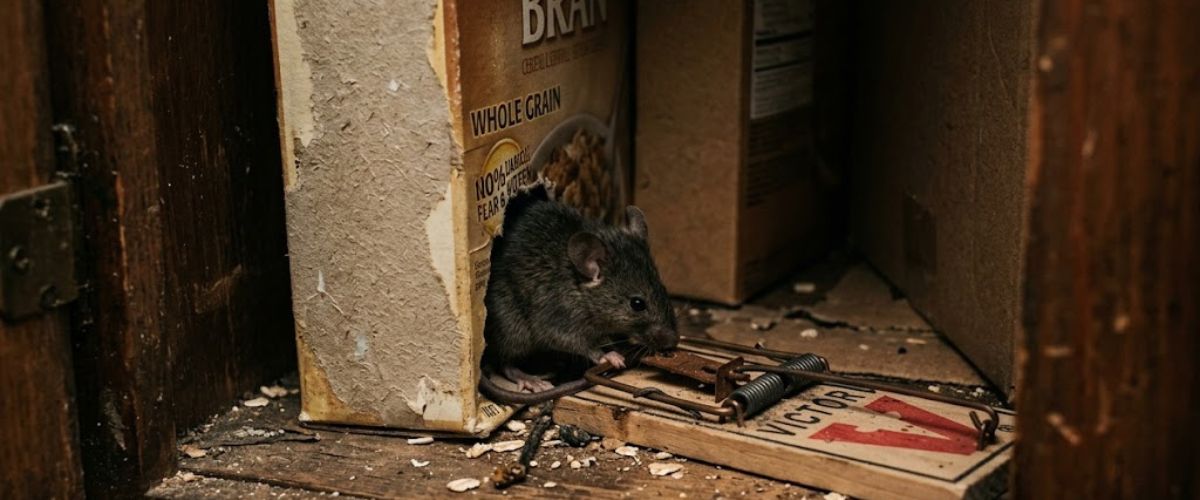
Why professional trapping outperforms DIY in Chattanooga
The trap type and the bait matter far less than where the trap is placed. This is the insight that separates professional trapping from DIY programs that run for weeks with no catches. Rodents are creatures of habit — they travel the same runways repeatedly and approach new objects with significant neophobia (fear of unfamiliar things). A snap trap placed on a runway produces catches within 24–72 hours. The same trap placed one foot off the runway, in an area the rodent doesn't travel, can sit for weeks with nothing.
The runways are different for each Chattanooga species. Roof rats travel along the tops of attic joists, along the wall-plate junction at the top of interior walls, and along the upper surfaces of roof trusses — elevated surfaces in the attic, not the floor. Traps placed on the attic floor catch nothing. Norway rats hug the base of walls at ground level, following the wall junction as a navigation guide. House mice run within 12 inches of a wall and investigate new objects more readily than rats — they're caught faster, but placement still matters.
Professional trapping starts with the inspection that maps the runways, nesting areas, and travel routes — then places traps directly on the confirmed activity zone.
Trap types we use for Chattanooga rodent jobs
Snap traps
The Victor Professional and equivalent commercial snap traps are the most reliable, fast-kill option for rat removal in Chattanooga attics and crawl spaces. Set in pairs on confirmed runways.
Best for: roof rats on attic joists · Norway rats along foundations
Multi-catch stations
Wind-up or mechanical multi-catch stations catch multiple mice without re-setting. Effective in high-density mouse populations in Chattanooga basement and garage situations.
Best for: house mice in garages · commercial kitchens · storage areas
Live-catch cage traps
Wire cage traps for properties where live release is the priority. Checked every 24 hours maximum. Animals released 1–2+ miles from property per Tennessee wildlife guidance.
Best for: humane removal requests · single-animal situations
CO₂ kill traps
Instantaneous CO2-powered kill traps. No bait required, no secondary poisoning risk, no chemical exposure. Higher per-unit cost but zero environmental footprint.
Best for: raptor-adjacent properties · pet-heavy homes · schools
Bait stations (exterior)
Tamper-resistant exterior bait stations for perimeter treatment of commercial properties and high-pressure Norway rat burrow sites. Locked, labeled, service-logged.
Best for: restaurant perimeters · warehouse loading docks · burrow sites
Tracking stations
Non-toxic flour or tracking-powder stations that record rodent footprints without catching or killing. Used to map activity zones before trap deployment and to confirm eradication after.
Best for: population assessment · post-treatment confirmation