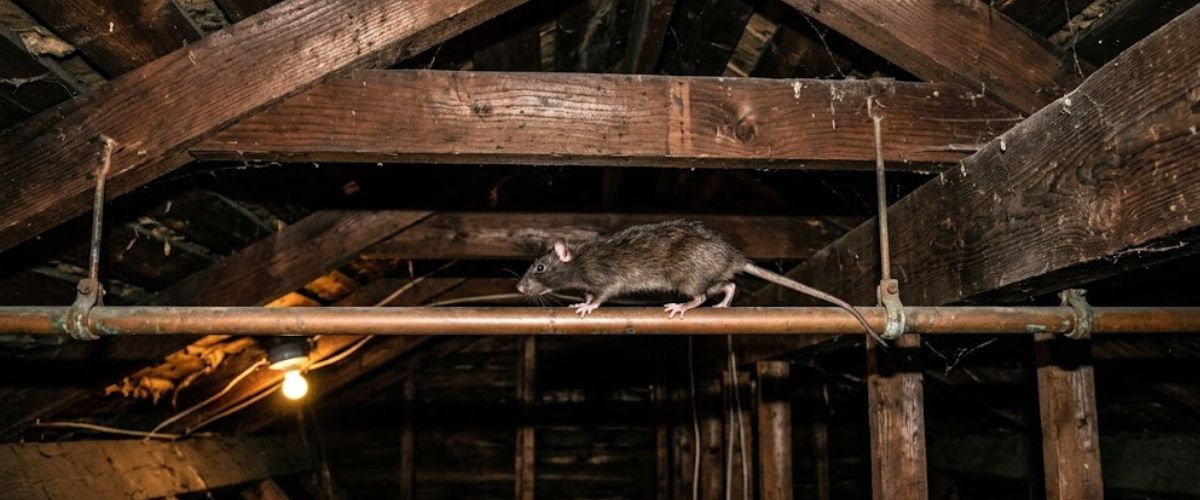
What is a roof rat and why is Chattanooga full of them?
Roof rats (Rattus rattus) are the slender, dark-furred, agile climbers responsible for most attic infestations in Chattanooga's older neighborhoods. Also called black rats or ship rats, they are not the stocky, ground-burrowing Norway rats you'd find near the Tennessee River docks and restaurant dumpsters — they are tree rats, moving through canopy, climbing masonry and wood, and entering homes high rather than low.
Chattanooga's geography makes it ideal roof-rat territory. The city sits in a humid subtropical valley bracketed by Lookout Mountain, Signal Mountain, and Missionary Ridge. The neighborhoods climbing those ridges — St. Elmo, Highland Park, Fairmount, Missionary Ridge itself, Lookout Mountain Town — are covered in mature pecan, oak, and hickory canopy that touches or overhangs rooflines constantly. Late summer mast crops (the nuts and seeds that fall from those trees) attract roof rats in large numbers each September and October, and when temperatures drop they follow the canopy highway directly to the warmest thing at the end of it: your attic.
The building stock compounds the problem. St. Elmo, Fort Wood, Highland Park, and the North Chattanooga riverfront neighborhoods are dense with homes built between 1880 and 1940. Original wood soffits deteriorate over time. Ridge vents and gable vents from that era were rarely screened with wire mesh fine enough to keep out a half-inch rat. Utility penetrations punched through in the 1960s and 70s during electrical and HVAC upgrades were rarely sealed properly. The result: beautiful heritage homes with dozens of entry points their owners have never seen.
How to identify a roof rat problem in your Chattanooga home
Roof rats are nocturnal, so most Chattanooga homeowners hear them before they see them. The pattern is distinctive: scratching, scurrying, or rolling sounds in the ceiling or attic that start shortly after dark and quiet down around dawn. The ceiling-level location is the telling detail — Norway rats generally stay lower, in wall voids and sub-floor areas; roof rats move through the attic and ceiling joist space.
Other signs to check:
- Droppings: Roof rat droppings are roughly 12–13 mm long with pointed ends — slightly smaller and more tapered than Norway rat droppings. You'll find them along the attic floor, on top of insulation, and near nesting material.
- Gnaw marks: Roof rats gnaw continuously to keep their incisors sharp. Fresh gnaw marks on attic joists, HVAC flex ducts, and electrical wiring are a serious sign — chewed wiring is the leading cause of unexplained house fires.
- Grease smears: The same sebaceous oils that darken a rat's fur also stain surfaces along their travel routes. Dark smear marks along the tops of attic joists and along roofline entry points are a reliable activity indicator.
- Nesting material: Shredded insulation, torn paper, chewed cardboard, and plant material packed into a corner of the attic or between insulation batts.
- Live or dead animals: Occasional sightings in the attic or, more rarely, in the living space if a rat has fallen through a ceiling gap.
- Tree-to-roof access: If a branch is within 6–8 feet of your roofline and roof rats are active in your neighborhood, assume they're using it.
The Chattanooga roof rat removal process
Our removal approach follows a strict sequence because the order matters. Sealing before trapping is complete traps animals inside walls where they die and cannot be retrieved. Trapping without sealing produces a temporary result — a new population moves in within weeks through the same entry points. The full sequence:
Free inspection
Full attic walk-through, exterior roofline assessment, and entry-point mapping. Species confirmed, extent estimated, treatment plan written.
Trap set
Snap traps and multi-catch stations placed along attic runways, near nesting areas, and at interior-facing entry points. Bait selected by season and infestation stage.
Follow-up visits
Every 5–7 days: remove catch, re-set traps, and assess whether the population is declining. Typically 2–4 visits over 2–3 weeks.
Exclusion sealing
Once catch rates drop to zero over two consecutive visits, we seal all identified entry points: vents, soffit gaps, fascia breaches, utility penetrations, and chimney flashing.
Prevention brief
Written summary of what was sealed, what tree branches remain a risk, and what to watch for if activity resumes. Optional follow-up monitoring schedule.
Roof rat entry points in Chattanooga homes
The five entry points we find most consistently in Hamilton County homes:
- Ridge vents: Unscreened or poorly screened ridge vents are the single most common roof-rat entry in Chattanooga. A rat can squeeze through a gap of ½ inch. Contractor-installed ridge vent without backing mesh is essentially an open door.
- Soffit gaps: Deteriorated wood soffits on pre-1970 homes develop gaps at the fascia-soffit junction, at corners, and where soffit panels have shifted or rotted. Vinyl soffit replacements in the 1980s–90s were often installed over existing gaps rather than sealing them.
- Gable vents: Louvered gable vents with missing or corroded screens. Common in Chattanooga homes of the 1920s–1960s.
- Roof vent pipes: Plumbing stack caps that have corroded or cracked, and HVAC line-set penetrations through the roofline without proper flashing.
- Chimney and flashing gaps: Step flashing separating from masonry along the chimney sides, and mortar joints that have cracked in older chimneys leaving voids large enough for a roof rat to enter.
Roof rat pressure by Chattanooga neighborhood
Not every neighborhood has equal roof-rat pressure. The pattern follows the canopy and the building stock:
- St. Elmo: The highest consistent roof-rat call volume in Chattanooga. Dense pecan, oak, and hickory canopy combined with the oldest housing stock in the city. Peak season runs September through January.
- Highland Park: Victorian-era homes along McCallie Avenue with mature oak corridors. Roof rats are active here year-round, with a sharp peak in the fall mast season.
- Fairmount: Early 20th-century neighborhood between Highland Park and Missionary Ridge. Consistent canopy pressure and older soffits.
- Missionary Ridge: Ridge-top homes with forested slopes on both faces. Roof rats move uphill through the tree canopy and enter from the ridge side.
- Lookout Mountain: Summit community above St. Elmo. Heavily wooded with year-round roof-rat activity on properties near the forest edge.
- North Chattanooga: River-corridor properties with humidity-driven roof rat and house mouse activity in crawl spaces and attics.
If you live in Hixson, East Brainerd, Brainerd, or the outer suburbs, roof rat activity is lighter — house mice are more common — but still present in homes with large trees near the roofline.
Hearing scratching in your attic? Same-day inspection available.
Call now — we answer 24/7 and schedule while you're on the phone.
Roof rat removal cost in Chattanooga
Pricing depends on the severity of the infestation, the age and condition of the roofline, the number of identified entry points, and whether attic decontamination is needed after removal. The table below reflects the typical ranges we see across Hamilton County single-family homes.
| Scope of work | Typical range | Notes |
|---|---|---|
| Initial inspection | Free | Interior attic + exterior roofline. Written findings. |
| Trapping only (2–3 visits) | $280–$450 | Light infestation. No exclusion sealing included. |
| Trapping + primary exclusion | $450–$900 | Sealing of 2–5 identified primary entry points after trapping completes. |
| Full roofline exclusion | $800–$1,800 | All vents, soffits, fascia, and utility penetrations. Pre-1940 homes trend higher. |
| Attic decontamination | $350–$900 | Antimicrobial treatment. Quoted separately from removal. |
| Insulation removal + replacement | $1,200–$3,500 | Full attic. Required after heavy, long-term infestations. |
All pricing is illustrative. Final pricing is given after the free inspection based on your specific property.
Roof rat prevention for Chattanooga homeowners
The four highest-impact prevention steps for Hamilton County homes:
- Trim canopy branches 6–8 feet from the roofline. This is the single most effective long-term measure. A roof rat can jump roughly 4 feet, so 6–8 feet of clearance is the recommended minimum. Consult an arborist for specific branch removal on mature heritage trees.
- Screen all attic vents with ½-inch hardware cloth. Fiberglass screen degrades and roof rats bite through it. Galvanized or stainless steel ½-inch mesh is the only durable solution for Chattanooga's humid climate.
- Inspect and seal the soffit-fascia junction annually. Especially in pre-1970 homes, this joint separates over time. Inspect in early September before peak season and seal any gaps with copper mesh or expanding foam backed by hardware cloth.
- Remove outdoor food sources before October. Fallen pecans, birdseed, pet food left outside, and accessible compost are all attractants that bring roof rats close to the structure and accelerate roofline pressure when temperatures drop.
Frequently asked questions — roof rat removal in Chattanooga
What does a roof rat look like compared to a Norway rat?
Roof rats are slender with a body length of 6–8 inches, a pointed nose, large ears, and a tail that is longer than their body — often 7–10 inches on its own. Their fur is typically dark brown to black on top and lighter on the belly. Norway rats are stockier, with blunt noses and shorter tails. In Chattanooga, if you're seeing a rat in your attic or moving through tree branches, it's almost certainly a roof rat.
Why are roof rats so common in St. Elmo and Highland Park?
Roof rats thrive where mature tree canopy provides uninterrupted travel routes to rooflines. St. Elmo and Highland Park both have dense canopies of pecan, oak, and hickory that hang over or touch the rooflines of late-1800s homes with original wood soffits and unscreened attic vents. It's the combination of the canopy corridor and the older building stock that makes these neighborhoods Chattanooga's heaviest roof-rat territory.
How do roof rats get into my attic?
The most common entry points in Chattanooga homes are unscreened ridge vents, open soffit gaps, deteriorated fascia boards, roof vent pipes without caps, and gaps where utilities penetrate the roofline. Roof rats only need a gap of about half an inch to squeeze through. Tree branches touching or overhanging the roof give them the highway to reach these points.
How long does roof rat removal take?
A single-family home in Chattanooga typically takes 1–3 service visits over 2–3 weeks. The first visit is the inspection and initial trap set. Follow-up visits remove caught animals and re-set traps. Exclusion sealing is done once active catch rates drop. For heavy infestations in older homes, the process can extend to 4–6 weeks.
Do I need to cut my trees back to prevent roof rats?
Trimming branches that overhang or touch the roofline by at least 6–8 feet is one of the most effective long-term prevention measures. Roof rats prefer the canopy highway; remove that bridge and their roofline access drops significantly. We advise on specific branches during the inspection; the actual trimming is done by an arborist.
What does roof rat removal cost in Chattanooga?
A standard removal job — inspection, trapping, and basic exclusion of the primary entry points — runs approximately $450–$900. Whole-house roofline exclusion adds $400–$1,200 depending on the roofline length, soffit condition, and number of vents. Attic decontamination and insulation replacement are quoted separately after inspection.