Why dead rodent removal matters in Chattanooga's climate
Chattanooga's humid subtropical climate makes dead rodent odor significantly worse than in drier regions. A dead rat in a Chattanooga attic or crawl space during July or August will be detectable within 24–48 hours and reach peak intensity within 3–5 days. In an enclosed, poorly ventilated space — behind a wall, between floor joists, under insulation — the odor can persist at a severe level for 3–6 weeks in summer humidity. In cooler winter conditions the timeline is slower but still stretches weeks.
Beyond the smell, a decomposing rodent in an inaccessible space attracts blowflies (Calliphoridae), which lay eggs on the carcass. Within 24–48 hours the larvae (maggots) hatch. If the carcass is accessible to the living space — near an electrical gap, a crack in a baseboard, or under a floor without proper seal — those flies and maggots can emerge into the home. This secondary infestation compounds the original problem significantly.
The correct response is fast removal, not waiting for the odor to dissipate on its own. In Chattanooga's climate, waiting rarely works and always takes longer than homeowners expect.
The decomposition timeline — what to expect in Chattanooga
Odor begins
Faint but detectable. Easily mistaken for general mustiness in older Chattanooga homes. Usually strongest in one room or near one wall.
Peak odor (summer) / onset (winter)
Unmistakable. In Chattanooga summer humidity, the smell fills the room and can be detected from adjacent spaces. Blowfly activity begins near the source area.
Sustained odor with fly activity
The odor remains severe. Adult blowflies emerge and begin appearing in the living space if the carcass is near any gap. The longer this goes, the harder the secondary cleanup.
Gradual resolution (if untreated)
Odor slowly declines as the carcass desiccates. In Chattanooga's summer humidity, this timeline can stretch to 10–12 weeks. Professional removal collapses this to 1–3 days post-treatment.
How we locate a dead rodent in your Chattanooga home
Finding a carcass inside a wall, under a floor, or buried in attic insulation requires a systematic approach. We use:
- Odor-concentration mapping: Moving room by room, floor by floor, systematically identifying the zone of strongest concentration. The odor is strongest closest to the source — a consistent mapping process narrows the location to a specific wall section, joist bay, or attic quadrant.
- Structural knowledge of rodent runways: Rats travel consistent routes. Knowing which walls contain plumbing chases, which joist bays connect to the exterior, and which ceiling cavities are accessible from the attic narrows the search to likely areas based on the species and known entry points.
- Thermal imaging: A decomposing body generates a heat signature detectable by infrared camera in some conditions — particularly useful in cooler weather when the temperature differential is clear.
- Minimal-access retrieval: Once located, we retrieve through existing utility openings, attic access points, or, if necessary, a small access panel cut at the lowest-damage location. We photograph the carcass in place and the removal area before closing.
Common dead rodent locations in Chattanooga homes
- Attic insulation: The most common location in St. Elmo, Highland Park, and Missionary Ridge heritage homes. Roof rats nest in attic insulation — they die where they live. Locating them requires moving insulation in the general odor-concentration zone.
- Wall voids: Rats travel wall cavities as runways. An animal that consumed bait elsewhere and retreated to a familiar wall route before dying can be 10–20 feet from the bait station or trap.
- Crawl spaces: Common in Chattanooga homes with pier-and-beam or block foundations. Crawl spaces in the humid subtropical climate are challenging because general moisture odor can mask and complicate the decomposition odor.
- Under kitchen or bathroom cabinetry: Rat runways behind kitchen base cabinets, under dishwashers, and behind bathroom vanities are common in older Chattanooga homes. A dead rodent here is one of the more accessible retrieval scenarios.
- Between floors in multi-story homes: The most difficult scenario. The joist bay between floors is often inaccessible from either above or below, requiring either a ceiling panel from below or a floor board removal from above.
Dead rodent removal and odor elimination process
Odor mapping
Room-by-room concentration assessment to narrow the source to a specific zone or structural area.
Location confirmation
Targeted investigation of the identified zone using structural knowledge, thermal imaging where applicable, and odor tracking.
Safe retrieval
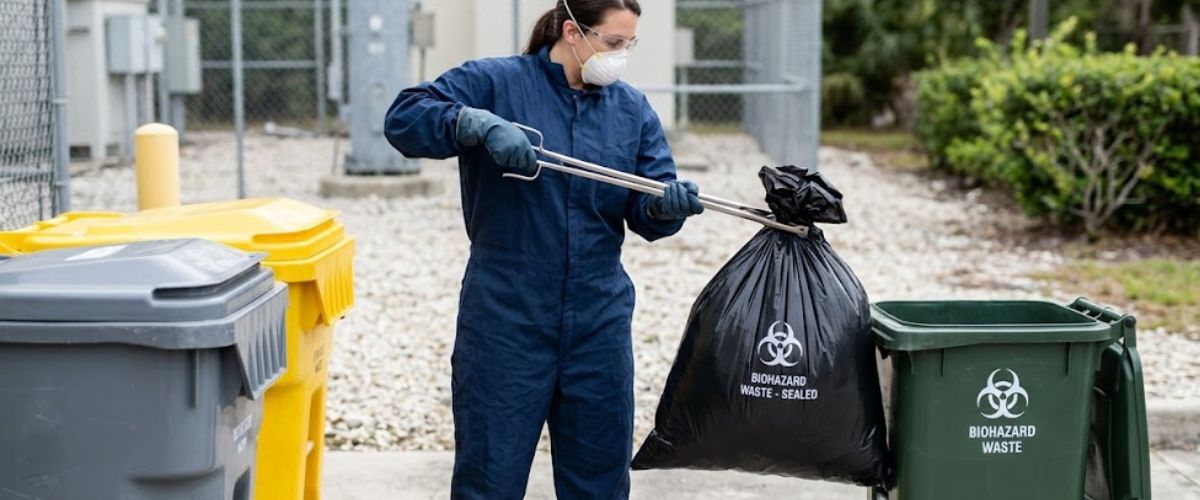
Carcass removed with PPE (gloves, Tyvek, N95 minimum) and sealed in biohazard-rated disposal bag. Documentation photo taken.
Area sanitation
Enzymatic cleaner applied to the immediate area. Secondary fly eggs or larvae treated if present.
Odor neutralization
Enzymatic odor neutralizer applied to affected surfaces and air-space if needed. Most odors resolve within 24–72 hours of removal + treatment.
Entry-point briefing
We advise on how and why the animal got there — usually bait consumed elsewhere, or an active infestation that needs full treatment.
Dead rodent removal: DIY vs. professional
If the carcass is in a visible, accessible location — a snap trap, an open area of the garage, or an accessible section of crawl space — DIY removal with gloves and a sealed bag is reasonable. The situations that warrant a professional call:
- The odor is strong but you can't locate the source
- The odor is strongest inside a finished wall
- The location is in an attic, tight crawl space, or between floors
- There are signs of fly activity (adult flies appearing suddenly, or maggots near a wall or floor area)
- The odor has been present for more than a week despite airing out the space
- You want enzymatic treatment to accelerate full odor resolution
Strong rodent odor and can't find the source?
We locate and remove carcasses from walls, attics, and crawl spaces. Same-day across Hamilton County.
Pricing for dead rodent removal in Chattanooga
| Scenario | Typical range | Notes |
|---|---|---|
| Accessible carcass (attic, crawl space, visible area) | $150–$250 | Includes retrieval and disposal. Area sanitation additional. |
| In-wall carcass location + retrieval | $200–$400 | Includes diagnostic mapping. Access panel cutting if required adds $100–$200. |
| Between-floor retrieval | $300–$550 | Most difficult scenario. Ceiling or floor access required in most cases. |
| Enzymatic odor neutralization (room/zone) | $150–$350 | Applied after carcass removal. Most odors resolve in 24–72 hours. |
| Full attic or crawl space sanitation | $400–$900 | Required after heavy or multi-carcass situations. See odor removal service. |
Frequently asked questions
How long does a dead rat smell last in Chattanooga's climate?
In Chattanooga's humid subtropical climate, a dead rat in an enclosed space will produce peak odor between days 3 and 10, and can continue for 3–6 weeks. Humidity significantly extends the timeline compared to drier climates — Chattanooga summers are particularly challenging. Professional removal plus enzymatic treatment collapses this to 1–3 days.
Can you find a dead rat inside a wall?
Yes. We use odor-concentration mapping, structural knowledge of typical runway routes, and thermal imaging in appropriate conditions. Once located, retrieval is through the smallest practical access point — existing utility openings first, access panels only when necessary.
Why is there a dead rat in my home if I haven't seen live ones?
The most common cause is anticoagulant rodenticide bait — either from a previous pest control operator or DIY poison products. Anticoagulant bait causes rodents to die 3–7 days after consumption, often far from where they ate it, in wall voids or attic spaces they use as rest areas.
What does dead rodent removal cost in Chattanooga?
Accessible carcass removal runs $150–$250. In-wall location and retrieval runs $200–$400. Enzymatic odor neutralization after removal is $150–$350 for a typical room or zone.
Will the odor go away on its own?
Eventually, yes — but in Chattanooga's humid climate that can mean 6–10 weeks of serious odor. Removal plus enzymatic treatment collapses the timeline to 1–3 days. Without removal, blowfly activity creates a secondary problem that compounds the original issue.