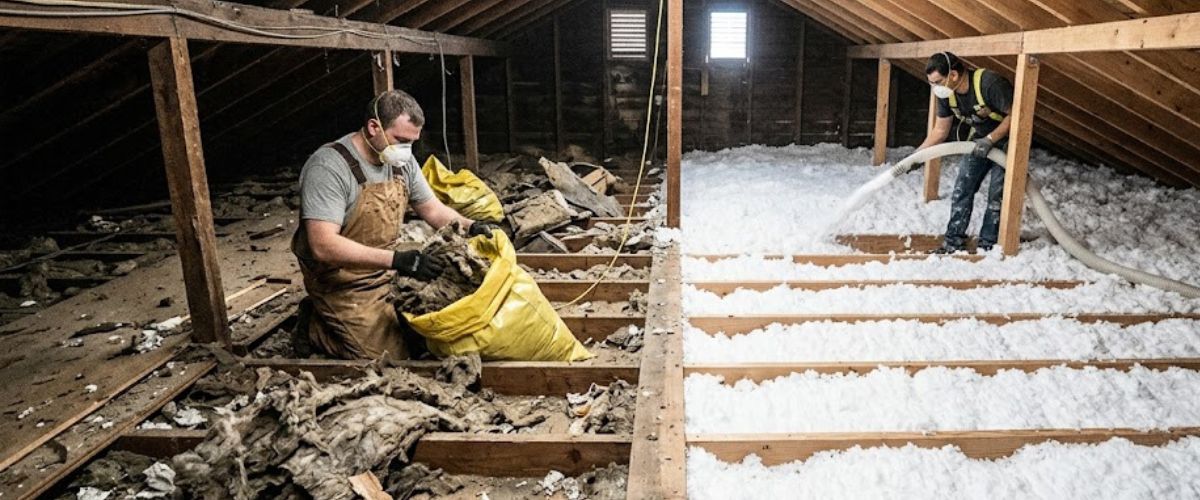
Why full attic restoration is sometimes necessary
Not every Chattanooga attic rodent infestation requires full restoration — but when it does, a partial cleanup is worse than none. Installing new insulation over structural surfaces still saturated with urine and fecal residue traps the contamination beneath a new material layer where it continues to generate odor and pathogen risk while remaining inaccessible for future cleaning. The restoration sequence exists precisely to prevent this outcome.
Roof rat infestations in Chattanooga's heritage neighborhoods — St. Elmo, Highland Park, Missionary Ridge, and Fairmount — most commonly require full restoration when the infestation has run for multiple seasons. A roof rat colony that has been using an attic as both nesting and latrine space for 2–3 years typically contaminates fiberglass batt insulation beyond remediation. The urine saturation compresses and displaces the batting, reducing its R-value; the fecal loading on the insulation facing and on the rafters below creates a persistent odor source; and the pheromone trails along the insulation surface attract subsequent animals even after the colony is resolved.
The attic restoration sequence
Attic inspection + scope
Free inspection establishing infestation extent, insulation contamination level, wiring condition, and entry point status. Written scope and estimate provided before work begins. Restoration not started until population control is complete and entry points are sealed.
Contaminated insulation removal
All contaminated insulation removed via negative-pressure vacuum equipment that contains debris within the attic and eliminates cross-contamination of living spaces. Material bagged and disposed. Removal is complete — no contaminated material left in place beneath new insulation.
Structural decontamination
All exposed rafter, sheathing, blocking, and structural surface HEPA-vacuumed and treated with EPA-registered disinfectant. Enzymatic odor neutralizer applied to all surfaces. Pheromone trail disruption treatment on entry-adjacent surfaces.
Wiring and structural assessment
All accessible wiring inspected for gnaw damage. Any damage documented and electrician referral made before new insulation is installed. This is the critical gate between decontamination and re-insulation — we don't insulate over uninspected gnawed wiring.
New insulation installation
New blown-in insulation installed to current IECC code R-value (R-49 for Chattanooga Climate Zone 4). Insulation type selected based on attic characteristics. New insulation depth map provided for future reference.
Pricing
| Scope | Typical range | Notes |
|---|---|---|
| Attic inspection + scope | Free | Full walk-through, contamination assessment, written scope and estimate. |
| Partial removal + decontamination | $800–$1,800 | Heavily contaminated zones removed; intact areas treated. New insulation quoted separately. |
| Full restoration (1,500–2,500 sq ft) | $3,000–$6,500 | Complete removal, decontamination, and new insulation to R-49. All-in. |
| New insulation only (after owner-removed contaminated insulation) | $1,200–$2,500 | Decontamination confirmation inspection required before new insulation is installed. |
Frequently asked questions
How do I know if my attic needs full restoration vs. just treatment?
Full restoration is indicated when: the infestation ran for more than one breeding cycle; insulation is visibly saturated with urine (yellow-brown discoloration, ammonia odor); fecal loading has compressed and displaced batting; or wiring gnaw damage requires an electrician before re-insulation. Single-season infestations caught early often need only decontamination, not full removal.
What does attic restoration cost in Chattanooga?
Complete restoration for a 1,500–2,500 sq ft home (removal + decontamination + new insulation to R-49): typically $3,000–$6,500. Partial removal + decontamination: $800–$1,800. Written line-item estimate provided after the free attic inspection.
How long does attic restoration take?
A standard restoration for a 1,500–2,500 sq ft home typically takes 1–2 days: removal and decontamination on day one, wiring assessment, and new insulation on day two. Larger or complex attics may take longer.
Will new insulation solve my attic odor problem?
Only if the decontamination phase is thorough before new insulation is installed. Installing new material over contaminated structural surfaces traps the odor beneath it. Our sequence is always: remove → decontaminate → inspect → install. We never compress or skip the decontamination phase.