Where Downtown Chattanooga's Norway rats come from
Downtown Chattanooga's Norway rat population has two overlapping source zones that sustain it regardless of what individual property owners do on their own footprints. Understanding these sources explains why Downtown Norway rat management requires a different mindset than suburban residential rodent control.
The Tennessee River corridor. Norway rats are exceptional swimmers and are established along every major waterway in the eastern United States. Chattanooga's Tennessee River waterfront — the strip along Riverfront Parkway, the Chattanooga Choo-Choo complex, and the blocks between the river and the Broad Street corridor — has a permanent Norway rat population that uses the riverbank, the storm drainage infrastructure, and the utility corridors between the waterfront and the commercial blocks as year-round habitat. This population doesn't disappear seasonally; it fluctuates in intensity but is always present, always pressing toward adjacent buildings, and always using the drainage connections between the riverfront and inland properties as travel corridors.
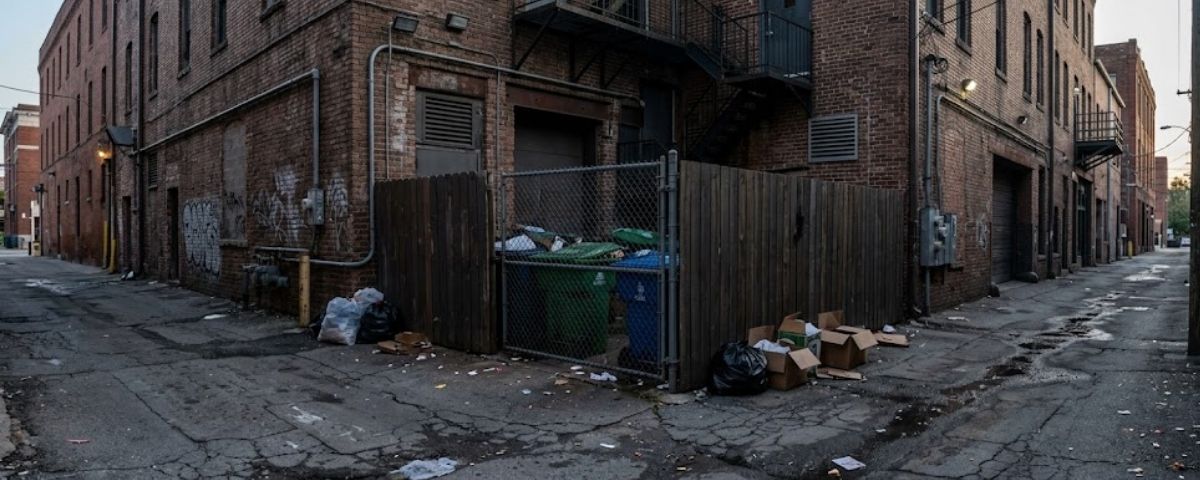
The restaurant corridor food waste. The restaurant, bar, and entertainment density along the Broad Street–Market Street–Main Street corridor generates some of the highest food waste volume per block in the state. Shared dumpster enclosures in the service alleys behind these blocks provide concentrated food sources that sustain the largest outdoor Norway rat colonies in Hamilton County. A rat that starts the night at a riverfront burrow can reach a dumpster enclosure three blocks inland, feed, and return before dawn — the distances are trivial for an animal that routinely travels 100–300 feet per night.
Which Downtown properties face the highest pressure
Not all Downtown properties face equal pressure. The highest-risk locations:
- Properties within two blocks of the riverfront: The storm drain and utility corridor connections between the river and adjacent buildings create a direct pathway that's independent of above-ground travel. Basements and ground-floor utility spaces in this zone face a different risk than those farther inland.
- Properties adjacent to or with shared alley access to restaurant dumpster enclosures: Any loading dock, service entry, or alley-adjacent foundation within half a block of a high-volume restaurant dumpster enclosure has sustained year-round Norway rat pressure from the food-waste colonies.
- Mixed-use buildings with ground-floor food service and upper-floor residential: The food-service operation on the ground floor creates the attractant; the residential units above are where the animals travel once inside the building through shared utility chases.
- Properties with accessible floor drains or aging sewer laterals: The sewer infrastructure beneath Downtown Chattanooga's older blocks has the same Norway rat population as the storm drain system. Properties with unsealed floor drains in basements or ground-floor utility rooms face the additional risk of sewer-source entry, particularly during storm events that pressurize the combined sewer system.
What actually works for Downtown properties
The two-layer approach that produces durable results for Downtown Chattanooga properties:
Layer 1 — Structural exclusion: Sealing all entry points between the outdoor environment and the interior. For Downtown properties, this means: exterior wall utility penetrations sealed with copper mesh and mortar; floor drains equipped with rodent-resistant covers; loading dock door sweeps and threshold seals maintained in good condition; and foundation cracks in below-grade areas sealed with mortar-compatible products. This layer prevents the outdoor population from establishing an indoor population regardless of how high the outdoor pressure is.
Layer 2 — Maintained exterior perimeter: Tamper-resistant bait stations along the foundation perimeter, in loading dock areas, and near dumpster enclosures reduce the outdoor population pressure on the building. For restaurant properties, this layer also satisfies health code documentation requirements when combined with service logs. For residential and office properties, maintained exterior stations keep population pressure below the threshold that drives active entry attempts even when the outdoor pressure is high.
The combination of thorough structural exclusion (layer 1) and maintained exterior perimeter treatment (layer 2) produces more durable results than either approach alone. Downtown's river-corridor Norway rat pressure doesn't go away — but it becomes manageable when the building is sealed and the perimeter is maintained.
See our Norway rat control program and drain and sewer prevention for the Downtown-specific service protocols.
Same-day rodent control across Hamilton County
Call now — we’ll schedule the inspection while you’re on the phone.