Why it matters which rat species you have
Roof rats and Norway rats are both common in Chattanooga — but they live in different places, enter through different points, and respond to different treatment approaches. Treating a Norway rat infestation with a roof-rat program, or vice versa, wastes time and money while the infestation continues. Before any treatment begins, knowing which species you're dealing with is the most important piece of information.
Physical differences: size, shape, and color
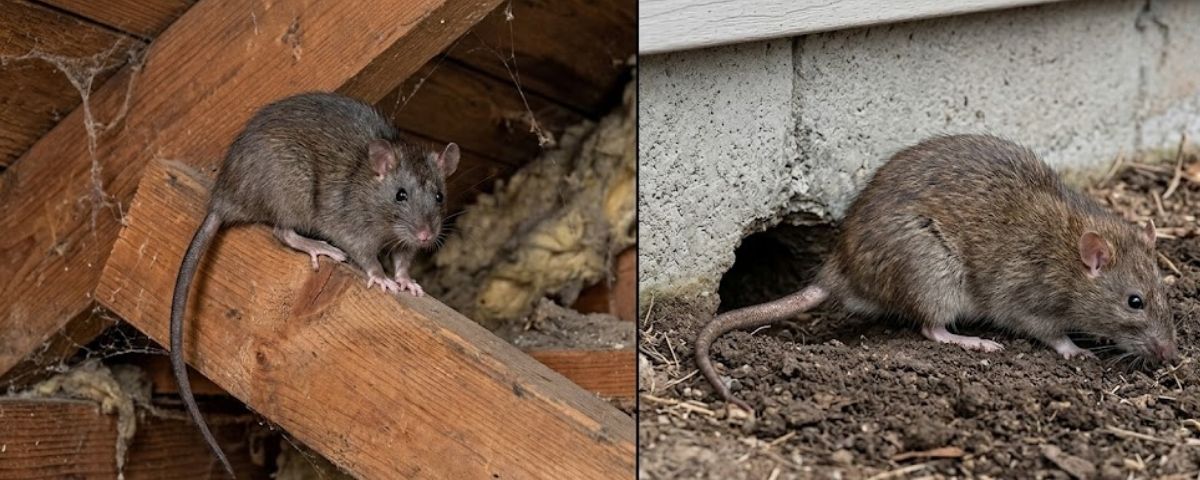
Roof rats (Rattus rattus, also called black rats or ship rats) are the slender, large-eared rat with a tail longer than its body. In Chattanooga, roof rats typically measure 13–18 inches from nose to tail tip and weigh 5–9 ounces. Their ears are large enough to fold forward and reach the nose. Their snout is pointed rather than blunt. Coat color ranges from dark brown to black on the back with a lighter (gray, tan, or white) underside. The most reliable physical indicator: the tail is longer than the head and body combined.
Norway rats (Rattus norvegicus, also called brown rats or sewer rats) are larger and heavier — 14–19 inches nose to tail, but weighing 10–17 ounces. Their build is stockier, their ears are smaller and furred, and their snout is blunt rather than pointed. Coat color is typically brown or gray-brown with a lighter underside. The tail is shorter than the head and body combined. Norway rats look more like the archetypal "big rat" — heavier, more muscular, and less agile than roof rats.
Where they live: the most reliable identifier
In Chattanooga, the most reliable way to identify species is location of activity — not appearance. The two species have almost no territorial overlap in practice:
- Roof rats are arboreal — they live in trees, travel through canopy, nest in attics and elevated spaces inside structures, and are almost never found in below-grade or at-grade areas like basements and crawl spaces. If you have activity in the attic, along the roofline, or in elevated cabinets and ceiling voids, the species is almost certainly a roof rat.
- Norway rats are ground-level burrowers — they live in soil burrows, travel along ground-level runways at the base of walls, enter through foundation gaps and floor drains, and are almost never found in attics. If you have activity in the basement, crawl space, garage at ground level, or outdoor burrows near the foundation, the species is almost certainly a Norway rat.
This distinction holds so consistently across Hamilton County that we rarely need the animal in hand to be confident in the species identification — the activity location tells us which rat we're dealing with nearly every time.
Droppings: a field identification guide
Droppings are often the first sign of infestation, and they're reliably different between species:
- Roof rat droppings: Roughly 12–13mm long, spindle-shaped (pointed at both ends), curved. Typically dark brown to black. Found in elevated locations — along rafters, on top of stored boxes in attics, along ceiling-level cabinets.
- Norway rat droppings: Roughly 18–20mm long, capsule-shaped (blunt at both ends), typically darker. Found at ground level — along wall-floor junctions, near floor drains, in basement corners, around outdoor burrow entrances.
- House mouse droppings (for comparison): Tiny — 3–6mm, rod-shaped with pointed ends, like a rice grain. Much smaller than either rat species. If droppings look like rice grains, you have mice, not rats.
Treatment differences that matter
Getting the species right changes the treatment approach:
For roof rats: Treatment focuses on the roofline — attic snap trap placement, roofline exclusion sealing (soffit-fascia junctions, ridge vents, gable vents, pipe collars), and canopy-to-roofline clearance assessment. Exterior bait stations are placed at the base of trees and along fence lines roof rats travel, not against the foundation. See our roof rat removal program.
For Norway rats: Treatment focuses on the ground level and below — exterior perimeter bait stations, burrow treatment at active burrow entrances, foundation gap sealing, and floor drain cover installation where sewer-source entry is suspected. Interior snap traps in basements and crawl spaces, not attics. See our Norway rat control program.
If you're not sure which species you have, a free inspection resolves the question before any treatment begins. We confirm species from activity location, droppings, and entry point evidence during the inspection visit.
Which neighborhoods have which species?
In Chattanooga, the species distribution follows the geography closely. Roof rats dominate the canopy-rich ridge neighborhoods: St. Elmo, Highland Park, Missionary Ridge, Fairmount, and Lookout Mountain. Norway rats dominate the river-corridor and commercial-density areas: Downtown, Southside, Hill City, North Chattanooga, and the older mid-city neighborhoods near drainage infrastructure. Both species can be present anywhere in the city — but these patterns are reliable enough to inform initial assumptions before the inspection confirms the species.
Same-day rodent control across Hamilton County
Call now — we’ll schedule the inspection while you’re on the phone.