The right materials — and why the wrong ones don't last
The most common exclusion mistake we see in Chattanooga homes is the wrong material in the wrong place. Spray foam in wood soffit joints. Steel wool in foundation gaps. Aluminum screen over original louvers. These aren't just ineffective — they cause problems. Foam cracks as wood moves seasonally. Steel wool rusts into a crumbling gap within months in Chattanooga's humidity. Aluminum mesh corrodes. And rodents push through all three if they're motivated enough.
The materials that actually work for long-term exclusion in Chattanooga's climate:
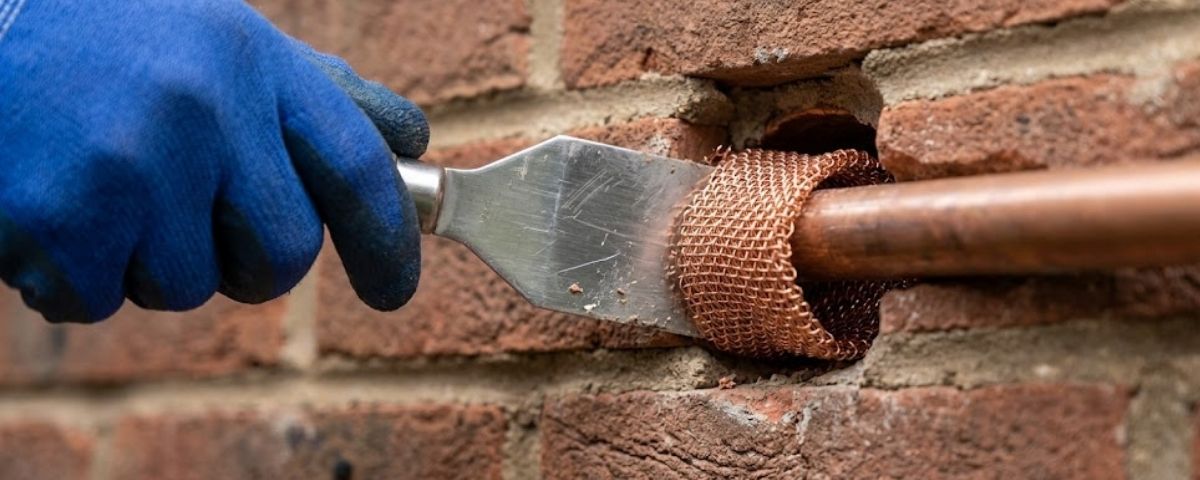
- Copper mesh: The best general-purpose gap sealing material. Pack it firmly into the void with a screwdriver or flat bar — rodents cannot chew through copper, and unlike steel wool, copper doesn't rust. Used for: utility penetration gaps, soffit-fascia junctions, foundation gaps, and any void too large for caulk alone.
- ½-inch galvanized hardware cloth: For vents, gable openings, and any gap too large for mesh packing. Cut to size and secure with stainless staples or screws. Galvanized (not aluminum) holds up in Chattanooga's humidity.
- Paintable elastomeric exterior caulk: For sealing over copper mesh in wood joints and for small gaps (under ¼ inch) in painted wood surfaces. "Elastomeric" means it flexes with seasonal wood movement rather than cracking.
- Hydraulic cement or mortar-matched products: For foundation cracks and masonry gaps. The correct product depends on the foundation type — poured concrete, brick, stone, or block each need a different approach.
- Expanding foam: Only for interior locations where seasonal movement isn't a factor and no moisture is present. Never in exterior wood joints, never in masonry. Rodents can push through foam; use copper mesh behind it at any exterior application.
Where to look first: the highest-probability entry points
Systematic entry-point surveys across Hamilton County produce a consistent ranking of where rats are most likely entering. Start here:
1. Roofline vents (roof rat entry #1). Ridge vents, gable vents, and the original louvered soffit vents on pre-1970 Chattanooga homes. Check from the attic interior with a strong flashlight — every point where exterior light enters is a potential entry point. Original gable vents in heritage homes should have ½-inch hardware cloth on the interior face.
2. Soffit-fascia junction (roof rat entry #2). The corner where the soffit meets the fascia board. In pre-1940 homes with original wood soffits, this junction has often opened as the wood has moved and weathered over decades. Inspect from the attic — you'll see light or gaps along the roofline edge.
3. Garage door bottom seal (house mouse entry #1). The rubber or vinyl seal at the base of the garage door. Inspect the corners — this is where seals fail first. If you can see light under the closed door at the corners, mice can enter. Replacement seals are standard hardware items.
4. Utility penetrations. Count them: water supply lines at the foundation, gas line, electrical service conduit, HVAC refrigerant line set, dryer vent, kitchen exhaust, bathroom exhaust vents, cable and telecommunications. Each has an annular gap around it that requires sealing. Copper mesh collar plus caulk or mortar as appropriate for the penetration location.
5. Foundation sill plate gap. The junction between the top of the foundation wall and the bottom of the first-floor framing. Present in virtually all pre-1980 Chattanooga homes. Copper mesh applied to the exterior face of this gap along the foundation top, sealed with backer rod and caulk.
6. Chimney flashing gaps (roof rat secondary). The step flashing at the chimney-to-roofline junction. Separation between step flashing and chimney masonry allows access to the attic framing cavity around the chimney. See our chimney rodent proofing service for the cap-plus-flashing approach.
Step-by-step: sealing a utility penetration
- Identify the gap: use a screwdriver or probe to assess the size of the annular gap around the pipe or conduit where it enters the foundation or wall.
- Clean the area: remove old foam, debris, or deteriorated caulk from the gap edges.
- Pack copper mesh: using a flat-bladed screwdriver, pack copper mesh firmly into the gap around the penetration. The mesh should be dense enough that it can't be pulled out by hand.
- Apply backer rod: for gaps over ½ inch, fill any remaining void with backer rod (foam rope) behind the copper mesh before caulking.
- Apply caulk or mortar: over the copper mesh, apply the appropriate sealant for the substrate — paintable exterior elastomeric caulk for wood and siding applications, mortar-matched product for masonry applications.
- Smooth and paint: caulk can be painted to match the existing surface finish after it cures (typically 24–48 hours).
When DIY exclusion is enough — and when it isn't
For a modern home with accessible utility penetrations at ground level, DIY exclusion is genuinely feasible. The materials are available at any hardware store, the technique is straightforward, and a motivated homeowner can close a dozen penetrations in a Saturday afternoon. This is the situation where doing it yourself is a reasonable approach.
For a pre-1940 heritage home in St. Elmo, Highland Park, or Missionary Ridge with original wood soffits requiring roofline access, material-compatible products, and attic interior work — professional installation produces more durable results, avoids the material incompatibility damage that common DIY choices cause, and includes the attic-interior inspection that identifies the entry points not visible from outside. See entry point detection and foundation gap sealing for the professional service equivalents.
The rule of thumb: if you can do the work without ladder access, and the substrate is modern construction, DIY is a reasonable choice. If the work requires roofline access, attic interior inspection, or heritage-compatible materials, professional installation is worth the cost.
Same-day rodent control across Hamilton County
Call now — we’ll schedule the inspection while you’re on the phone.