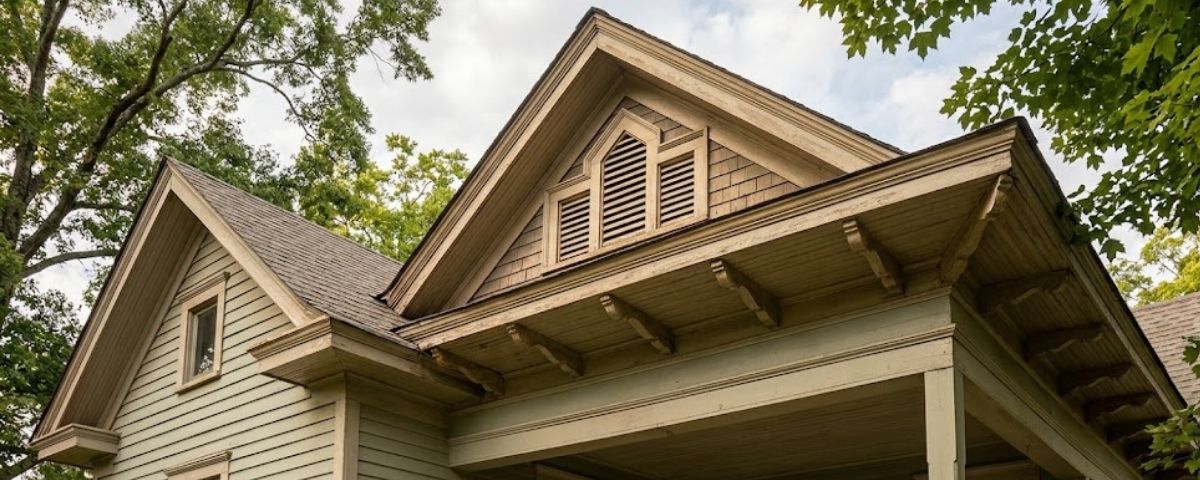
Why modern exclusion materials fail on historic homes
The most common mistake in Chattanooga historic home exclusion work is applying modern construction products to 100-year-old materials that respond differently. Three products cause specific problems:
Expanding foam in wood joints. Pre-1940 Chattanooga homes with original wood soffits experience seasonal wood movement — the boards expand and contract with humidity cycles throughout the year. Expanding foam cures rigid. When the wood moves and the foam doesn't, the foam cracks, the bond breaks, and the gap reopens — sometimes wider than before the foam was applied. The visual result is a sealed gap that becomes an unsealed gap within one to two seasons without any additional deterioration of the wood itself.
Expanding foam in masonry. Stone and brick foundations from the pre-1940 era have mortar compositions that were mixed on-site from natural materials, producing soft, somewhat porous mortar that allows the foundation to breathe and shed moisture. Sealing a masonry gap with expanding foam blocks this moisture movement — moisture that was previously exiting through the joint accumulates behind the foam, accelerating spalling and joint failure in the surrounding masonry. The rodent problem is addressed temporarily while a masonry problem is created that costs more to fix.
Aluminum mesh over original wood surfaces. Aluminum corrodes in contact with the tannins in aged wood and in Chattanooga's humidity, producing white powdery oxidation that discolors adjacent wood surfaces and eventually compromises the mesh's structural integrity. The screen installed with aluminum mesh over a historic louver may be structurally failed within 3–5 years of installation while appearing intact from outside.
Heritage-compatible materials that actually work
Copper mesh. Copper doesn't rust, can't be chewed through by rodents, and doesn't react with wood tannins or masonry in a damaging way. Packed firmly into a void and sealed over with compatible caulk or mortar, copper mesh is the most durable general-purpose exclusion material for historic construction. It's used by preservation contractors precisely because it's compatible with the original materials in ways that modern alternatives aren't.
Paintable elastomeric exterior caulk. "Elastomeric" means the cured caulk has rubber-like flexibility — it stretches and compresses with seasonal wood movement rather than cracking. Applied over copper mesh in wood joint gaps, paintable elastomeric caulk produces a seal that accommodates the original wood's seasonal behavior while preventing rodent entry. Color-matched to the existing paint, the repair is nearly invisible.
½-inch galvanized hardware cloth. Galvanized rather than aluminum — zinc coating holds up in Chattanooga's humidity where aluminum oxidizes. Applied over the interior face of original louvered gable vents, galvanized hardware cloth preserves the exterior louver appearance (the historic character visible from the street) while preventing rodent entry through the vent opening.
Mortar-matched products. For stone and brick foundation gaps, the sealant over copper mesh should match the composition and color of the existing mortar as closely as possible. Pre-1940 Chattanooga mortars are typically soft (high lime content) — modern Portland cement mortars are too rigid and too strong, causing mortar failure and stone cracking when used to repoint soft-mortar heritage foundations. A lime-based or hydraulic cement product matched to the existing mortar composition is the correct choice.
Balloon framing: the entry point that modern homes don't have
Pre-1930 Chattanooga homes were typically built with balloon framing — a construction method where stud bays run continuously from the foundation sill to the roof plate without the fire blocking present in modern platform framing. This means the interior of the wall cavity connects directly between the foundation and the attic: a mouse that enters through the foundation sill plate gap is in an open channel that leads directly to the attic without any interior barrier.
In balloon-frame homes, entry-point detection and sealing must address both ends of this channel: the exterior entry point (the foundation sill plate gap, foundation cracks, or utility penetrations at the lower end) and the attic-face of the wall cavity (where blocking can be installed on the interior to interrupt the channel). This is an approach that differs meaningfully from modern platform-frame homes where each floor level provides its own fire blocking that also serves as a rodent barrier within the wall cavity.
National Register listing and local historic districts
Properties on the National Register of Historic Places are subject to specific guidance on alterations, but National Register listing alone doesn't restrict what a private property owner does on their own property — the restrictions only apply when federal money or permits are involved. However, properties within a locally designated historic district (such as the Fort Wood Historic District adjacent to Highland Park) may have design review requirements for exterior alterations. Our exclusion work in these areas uses materials consistent with preservation guidance and can be coordinated with any required review process before work begins. See our historic home rodent control program for the complete approach.
Same-day rodent control across Hamilton County
Call now — we’ll schedule the inspection while you’re on the phone.