What roof rats actually damage in a Chattanooga attic
Roof rat attic infestations in Chattanooga homes — particularly in the heritage neighborhoods of St. Elmo, Highland Park, and Missionary Ridge where infestations can run for multiple seasons before discovery — produce a consistent pattern of damage that falls into four categories. Understanding these categories helps homeowners assess the scope of repair needed and communicate with contractors accurately.
1. Insulation damage (most common, most extensive). Roof rats use attic insulation as both runway and latrine. The urine saturation in fiberglass batt or blown-in insulation that results from years of rat activity produces yellow-brown discoloration, ammonia odor, and compression of the insulation from repeated use as runway surfaces. In multi-year infestations, the insulation may be so thoroughly contaminated that in-place decontamination is insufficient — the material must be removed, the structural surfaces beneath treated, and new insulation installed. This is the most common Chattanooga attic repair scope, and it's also the most expensive single line item.
2. Electrical wiring gnaw damage (highest risk). Roof rats gnaw wire insulation throughout their occupied territory. The Romex sheathing used in residential construction from the 1960s through the 2000s is a target — rats strip the outer plastic sheathing to reach the softer plastic insulation on the individual conductors within. This exposed-conductor condition in an attic creates arcing risk, which is a documented house fire cause. The gnaw damage to the outer sheathing appears as clean-edged cuts in the gray or white plastic exterior; the inner conductor insulation may be exposed or damaged underneath.
The critical action: do not re-insulate an attic without first having the accessible wiring inspected by a licensed electrician. We photograph all accessible wiring conditions during the attic inspection and flag any gnaw damage for electrician review before the attic restoration proceeds. This is a non-negotiable step in our attic restoration program.
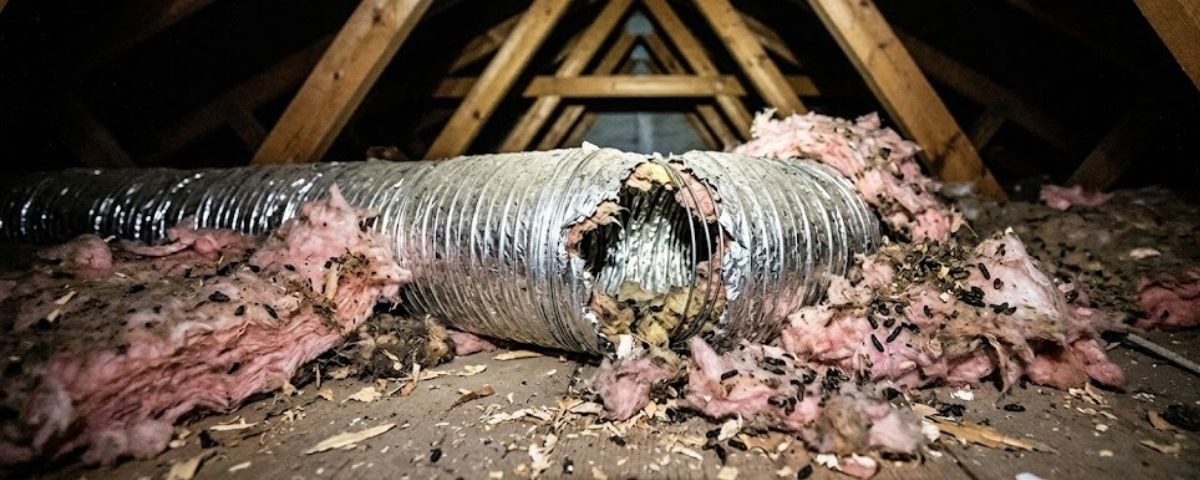
3. Flex ductwork damage. HVAC flex duct in Chattanooga attics is a favorite roof rat activity zone — the duct surface is warm in winter, protected, and comfortable. Rats nest on and around flex duct, stripping the outer insulation jacket, puncturing the inner liner, and occasionally nesting inside the duct itself. Each puncture in the duct liner reduces HVAC efficiency (conditioned air escapes into the attic rather than reaching the living space) and allows unconditioned attic air into the duct system. A home with extensively damaged flex duct can lose 20–30% of its HVAC efficiency.
4. Pipe foam and mechanical insulation. The foam insulation on hot water pipes, refrigerant lines, and supply pipes in attics is frequently stripped by roof rats. This is primarily a comfort and efficiency issue — stripped pipe insulation allows heat loss from hot water lines and condensation on refrigerant lines — rather than a structural one. Replacement is straightforward with new foam tube stock from hardware stores or with spray foam if the pipe is in an inaccessible location.
The repair sequence that produces durable results
Attic rat damage repair must proceed in the correct sequence to avoid problems that create more work than they prevent:
- Population control first. Snap trap program until catch rate drops to zero and activity signs stop accumulating. Never seal or repair while live animals are present.
- Entry point sealing. All identified roofline and attic entry points sealed before repair begins. New insulation installed over unaddressed entry points will be damaged again within a season.
- Contaminated insulation removal. Via negative-pressure vacuum equipment — this is how you remove contaminated insulation without distributing particles into the living space through ceiling penetrations. See contaminated insulation removal.
- Structural surface decontamination. HEPA vacuuming of exposed rafters, sheathing, and blocking, followed by EPA-registered disinfectant and enzymatic odor neutralizer application. See sanitation and disinfection.
- Wiring inspection. Licensed electrician assessment of all accessible wiring in the attic. Any gnaw-damaged wiring identified and repaired before re-insulation.
- Duct assessment and repair. Flex duct sections inspected for punctures, liner damage, and jacket stripping. Minor punctures patched with HVAC mastic; damaged sections replaced.
- New insulation installation. Blown-in insulation installed to current IECC code R-49 for Chattanooga Climate Zone 4. Insulation installed after all of the above is complete — never before.
This sequence is built into our attic restoration program and is the approach we follow on every attic restoration project in Hamilton County. Skipping or compressing any step produces the kind of attic restoration that needs to be re-done within a season — which is more expensive than doing it correctly once.
Getting an accurate damage assessment
A free property damage inspection produces a written line-item report identifying which damage categories are present, what the scope in each category is, and what the estimated remediation cost is for each line. This report is formatted for use with insurance adjusters and with remediation contractors and gives you an accurate picture of what you're dealing with before any work begins.
Same-day rodent control across Hamilton County
Call now — we’ll schedule the inspection while you’re on the phone.